Stay informed this summer: Your guide to understanding ozone pollution and smoke impacts on air quality in Colorado
Updated: May 28, 2026

For immediate release
RAQC media contact: Jenn Fields, jfields@raqc.org
CDPHE media contact: Zachary Aedo, zachary.aedo@state.co.us
PDF file: Información en español.
Denver (May 28, 2026): The Colorado Air Pollution Control Division and the Regional Air Quality Council are highlighting resources to help residents stay informed and prepare for potential air quality changes during the summer. While the division monitors the state’s air quality year-round, the warmer weather brings factors that can impact the air we breathe. The two main outdoor air quality issues during summer in Colorado are ozone pollution and particulate matter pollution from smoke.
“Hot and dry conditions can quickly change our air quality, so our team is closely monitoring it as the season unfolds,” said Michael Ogletree, the senior director of state air quality programs at CDPHE. “We have easy-to-understand resources to help everyone learn more and get timely air quality updates.”
Ground-level ozone pollution
Ground-level ozone pollution forms when heat and sunlight react with air pollutants from sources like vehicle exhaust and industrial operations, and it also exists naturally in the air. Ozone high up in the atmosphere protects people from harmful ultraviolet radiation, but when it is at ground-level where people live, it can pose health concerns when breathed in. Ozone pollution can cause throat irritation, coughing, and sometimes chest pain. While anyone spending time outdoors can be affected, those with respiratory conditions, children, older adults, and pregnant individuals are most vulnerable.
“We have good air quality strategies and programs in place, and we’re making progress on ozone pollution on the Front Range, but there’s still work to do,” said Mike Silverstein, executive director of the Regional Air Quality Council. “Staying informed and knowing the actions you can take on ozone alert days can bring down our emissions and help you protect your health at the same time.”
Particulate matter pollution
During the summer, wildfire smoke is the primary driver of particulate matter pollution—tiny, microscopic particles found in smoke, dust, and haze. Even if wildfires are distant, smoke can travel long distances and impact air quality across the state. Particulate matter pollution can also come from any sort of vehicle or facility that burns fuel. Breathing particulate matter pollution can lead to shortness of breath, wheezing, and increased risk of cardiovascular and respiratory distress. People with heart or lung disease, older adults, children, and people working or exercising outdoors are especially vulnerable.
Resources to stay informed
CDPHE’s meteorologists provide real-time updates on air quality conditions, and CDPHE partners with the Regional Air Quality Council to provide options for Coloradans to receive updates and stay engaged. Available resources include:
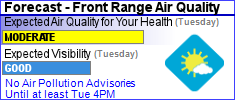
- CDPHE air quality alerts: Receive email notifications from the air division by subscribing to air quality alerts by location. Subscribers to the “ozone front range” list receive daily emails from May 31 to Aug. 31 each year. The daily emails clearly indicate whether an Ozone Action Day Alert is in effect for the Denver metro and northern Front Range area in Colorado. Subscribers to all other lists will only receive an email alert if outdoor air pollution, including particulate matter levels, may exceed federal health standards for the given county. These forecasts are also available on the division’s website in English and Spanish.
- CDPHE Colorado Smoke Blog: For the most up-to-date information on smoke and air quality impacts, visit the Colorado Smoke Blog. This resource can help residents understand how smoke is impacting their area, including timely updates on wildfires, prescribed fire activity, and health tips.
- CDPHE air quality summaries: Visit the Colorado air quality summary web page for the latest advisories, data, and Air Quality Index level by location across the state.
- Regional Air Quality Council: To receive Ozone Action Day Alerts by text, subscribe through the Regional Air Quality Council.
Optional ways for Coloradans to take action
All of Colorado meets federal health standards for particulate matter pollution in outdoor air. The state has taken steps to reduce emissions that form ground-level ozone pollution in the parts of Colorado that do not meet federal health standards. While the state recognizes that it is not always possible for people to make changes to their daily routines and schedules, individual Coloradans can also make a difference to help reduce ground-level ozone pollution in several ways. Follow suggestions through the Regional Air Quality Council’s Simple Steps. Better Air. program, such as:
- Filling up your gas tank after 5 p.m.
- Using public transportation, walking, bicycling, or carpooling to reduce air pollution emissions whenever possible.
- Mowing your lawn in the evening and, if possible, avoiding gas-powered lawn equipment.
Stay connected
- Sign up for RAQC Simple Steps. Better Air. summer ozone email or text alerts.
- Sign up for CDPHE Air Pollution Control Division email updates
- Explore upcoming public participation opportunities on air quality
- Email cdphe.commentsapcd@state.co.us with questions or comments on air quality.
—————————————————–
About the Colorado Department of Public Health and Environment and its Air Pollution Control Division: CDPHE provides services to promote healthy people in healthy places and uses evidence-based practices to foster a sustainable environment for current and future generations of Coloradans to thrive. CDPHE pursues its mission through multiple programs and activities to advance Coloradans’ health and wellness and protect the state’s environment. The Air Pollution Control Division of CDPHE works to protect air quality for all Coloradans, no matter where they live. The division monitors air pollution, develops informed proposals to address air pollution, enforces air quality requirements, and promotes education and engagement on air quality issues. Visit CDPHE’s website to learn more.
About the Regional Air Quality Council: The RAQC is an independent nonprofit designated by the governor as a lead air quality planning organization for Colorado’s Front Range. The RAQC works with state agencies to create plans to improve air quality and run programs that protect our health, environment, and economy. We serve a nine-county region that is out of compliance with federal standards for ground-level ozone that includes Adams, Arapahoe, Boulder, Broomfield, Denver, Douglas, Jefferson, most of Larimer, and Weld counties. Visit our website to learn more.